Collaborative Spectrum Monitoring

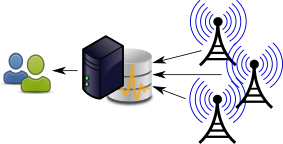
The ElectroSense network was a crowd-sourcing initiative to collect and analyse spectrum data. It used small radio sensors based on cheap commodity hardware and offers aggregated spectrum information over an open API.

The initiative's goal was to sense the entire spectrum in populated regions of the world and to make the data available in real-time for different kinds of stakeholders which require a deeper knowledge of the actual spectrum usage.

ElectroSense was an open initiative in which everyone can contribute with spectrum measurements and access the collected data.

Datasets

ElectroSense provided access to large-scale spectrum datasets, including power spectral density (PSD) and I/Q data collected via distributed low-cost sensors. Users could download historical measurements or request data through the open API. Technology Classification Measurements

The full dataset of technology classification measurements as described in our Infocom '23 paper:

A Framework for Wireless Technology Classification using Crowd-sensing Platforms A. Scalingi, D. Giustiniano, R. Calvo, N. Apostolakis, G. Bovet The 18th ACM International Conference on Mobile Systems, Applications and Services (MobiSys), IEEE Infocom 2023, New York, USA, May 2023 URL

Open Source

The ElectroSense project published its hardware and software as open source. Designs for sensors and software components were made publicly available for collaboration and transparency.

Browse our repositories: ElectroSense on GitHub.

Publications

The ElectroSense team has produced several scientific papers describing the system architecture, signal processing methods, and big data analytics.

An extensive description of the ElectroSense project, its goals, technology and contribution to the scientific community can be found in our magazine article:

Electrosense: Open and Big Spectrum Data
S. Rajendran, R. Calvo-Palomino, M. Fuchs, B. Van den Bergh, H. Cordobés, D. Giustiniano, S. Pollin, V. Lenders
IEEE Communications Magazine, January 2018
URL

Citing ElectroSense

If you create a publication (including web pages, papers published by a third party, and publicly available presentations) using data from ElectroSense, you should cite the above magazine article.

Articles

Learning the unknown: Improving modulation classification performance in unseen scenarios
E. Perenda, S. Rajendran, G. Bovet, S. Pollin, M. Zheleva
IEEE INFOCOM 2021 - IEEE Conference on Computer Communications, 2021, pp. 1-10, May 2021 URL
Large Scale Collaborative Detection and Location of Threats in the Electromagnetic Space
D. Giustiniano, V. Lenders, S. Pollin
Book chapter in Palestini C. (eds) Advanced Technologies for Security Applications. NATO Science for Peace and Security Series B: Physics and Biophysics, June 2020 URL
Large‐scale Wireless Spectrum Monitoring
S. Rajendran, S. Pollin
Book chapter in Spectrum Sharing (eds C.B. Papadias, T. Ratnarajah and D.T. Slock), April 2020 URL
SkySense: Terrestrial and Aerial Spectrum Use Analysed Using Lightweight Sensing Technology with Weather Balloons
B. Reynders, F. Minucci, E. Perenda, H. Sallouha, R. Calvo-Palomino, Y. Lizarribar, M. Fuchs, M. Schäfer, M. Engel, B. Van den Bergh, S. Pollin, D. Giustiniano, G. Bovet, V. Lenders
The 18th ACM International Conference on Mobile Systems, Applications and Services (MobiSys), 15-19 June 2020, Toronto, Canada URL
Electrosense+: Crowdsourcing Radio Spectrum Decoding using IoT Receivers
R. Calvo-Palomino, H. Cordobés de la Calle, M. Engel, M. Fuchs, P. Jain, M. Liechti, S. Rajendran, M. Schäfer, B. Van den Bergh, S. Pollin, D. Giustiniano, V. Lenders
Computer Networks, vol. 174, June 2020 URL
Crowdsourced wireless spectrum anomaly detection
S. Rajendran, V. Lenders, W. Meert, S. Pollin
IEEE Transactions on Cognitive Communications and Networking, vol. 6, no. 2, pp. 694-703, June 2020 URL
Unsupervised Wireless Spectrum Anomaly Detection With Interpretable Features
S. Rajendran, W. Meert, V. Lenders, S. Pollin
IEEE Transactions on Cognitive Communications and Networking, vol. 5, no. 3, pp. 637-647, September 2019 URL
Automatic Modulation Classification Using Parallel Fusion of Convolutional Neural Networks
E. Perenda, S. Rajendran, S. Pollin
Third International Balkan Conference on Communications and Networking, 10-12 June 2019, Skopje, North Macedonia URL
Collaborative Wideband Signal Decoding using Non-coherent Receivers
R. Calvo-Palomino, H. Cordobes de la Calle, F. Ricciato, D. Giustiniano, V. Lenders
ACM/IEEE International Conference on Information Processing in Sensor Networks (IPSN 2019), 14-16 April 2019, Montreal, Canada URL
SAIFE: Unsupervised Wireless Spectrum Anomaly Detection with Interpretable Features
S. Rajendran, W. Meert, V. Lenders, S. Pollin
IEEE International Symposium on Dynamic Spectrum Access Networks (DySPAN 2018), 22-25 October 2018, Seoul, South Korea URL
Deep Learning Models for Wireless Signal Classification with Distributed Low-Cost Spectrum Sensors
S. Rajendran, W. Meert, D. Giustiniano, V. Lenders, S. Pollin
IEEE Transactions on Cognitive Communications and Networking, 11 May 2018 URL
LTESS-track: A Precise and Fast Frequency Offset Estimation for Low-cost SDR Platforms
R. Calvo-Palomino, F. Ricciato, D. Giustiniano, V. Lenders
ACM Workshop on Wireless Network Testbeds, Experimental evaluation & Characterization (WINTECH), Oct 2017, Utah, USA URL
Measuring Spectrum Similarity in Distributed Radio Monitoring Systems
R. Calvo-Palomino, D. Giustiniano, V. Lenders
Tyrrhenian International Workshop on Digital Communications (TIWDC 2017), 18-20 September 2017, Mondello (Palermo), Italy URL
Crowdsourcing Spectrum Data Decoding
R. Calvo-Palomino, D. Giustiniano, V. Lenders, A. Fakhreddine
IEEE INFOCOM 2017, 1-4 May 2017, Atlanta, GA, USA URL
A Software-defined Sensor Architecture for Large-scale Wideband Spectrum Monitoring
D. Pfammatter, D. Giustiniano, V. Lenders
ACM/IEEE International Conference on Information Processing in Sensor Networks (IPSN 2015), 13-16 April 2015, Seattle, USA
URL

Demos

Electrosense - Spectrum Sensing with Increased Frequency Range (Demo)
F. Minucci, B. Van den Bergh, S. Rajendran, D. Giustiniano, H. Cordobés de la Calle, M. Fuchs, R. Calvo-Palomino, V. Lenders, S. Pollin
The 15th International Conference on Embedded Wireless Systems and Networks (EWSN 2018), 14-16 February 2018, Madrid, Spain
URL
Electrosense: Crowdsourcing Spectrum Monitoring (Demo)
B. Van den Bergh, D. Giustiniano, H. Cordobes de la Calle, M. Fuchs, R. Calvo-Palomino, S. Pollin, S. Rajendran, V. Lenders
IEEE International Symposium on Dynamic Spectrum Access Networks (DySPAN 2017), 6-9 March 2017, Baltimore, MD, USA
URL
A Low-cost Sensor Platform for Large-scale Wideband Spectrum Monitoring (Demo)
R. Calvo-Palomino, D. Pfammatter, D. Giustiniano, V. Lenders
ACM/IEEE IPSN 2015, 13-16 April 2015, Seattle, USA
URL

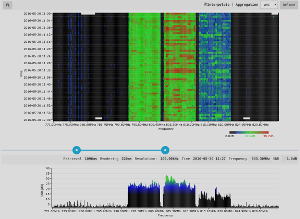
ElectroSense enabled users to monitor the spectrum of any sensor worldwide using an interactive web app.
schema
Monitor

Interactive Web App

Live and historical spectrum data was accessible through an interactive web interface.

API

API

Access real-time spectrum data measurements through an open API.

Setting up your own sensor is easy and cheap. You only need a simple single-board computer, an SDR dongle and an antenna. We have tested several computers and antennas and provide you with our recommended setup below.

Antenna

The right antenna for your setup depends on the frequency range you are interested in and if you want to measure in- or outdoors. Here is a table of antennas that we use in different setups with their respective properties, advantages and disadvantages. If you are using other antennas, feel free to send us your hardware setup so we can continuously extend this list.

Model Frequency Range Gain Size Remarks Price Buy
RTLSDR Default 15cm Antenna which comes with most RTL-SDR dongles
30dbi DVB-T antenna 174-230 MHz, 470-862MHz 30dBi 18cm ~12€  
Frequency Extension Board
RaspberryPi

From the beginning of the project, ElectroSense aimed for large-scale deployments using affordable hardware. Sensors were designed using cheap software-defined radios such as RTL-SDR dongles. However, these sensors don't cover all the interesting frequency bands, but rather come with a limited frequency range between 20MHz and 1.8GHz. To overcome this issue, while still providing sensors at a reasonable price, we have designed a frequency extension board. In combination with the RTL-SDR, it allows spectrum monitoring from few kHz and up to 6GHz. The board is connected to the Raspberry Pi via a USB port to exchange control data and power. It is equipped with 4 SMA antenna inputs and 1 SMA output to be connected to the RTL-SDR. In principle, the board can be used with any other SDR as its functionality is independent from the RTL dongle. The design is openly available on Github.


Raspberry Pi Image
RaspberryPi

In order to turn any Raspberry Pi device into an ElectroSense sensor we have created an image based on Raspbian. It includes all software needed to connect a node to the ElectroSense network. You just need to copy it to an SD Card, insert the card into your Raspberry Pi and you are ready to go.


GNU Radio Blocks
GNURadio

Basically any device compatible with GNU Radio can join the ElectroSense network. We have developed some custom blocks for you. For more details have a look at the Github repository.

Samples & More
Github

Even more software and sample code can be found in our Github profile